
Most companies claim pay equity.
Synopsys proved it.
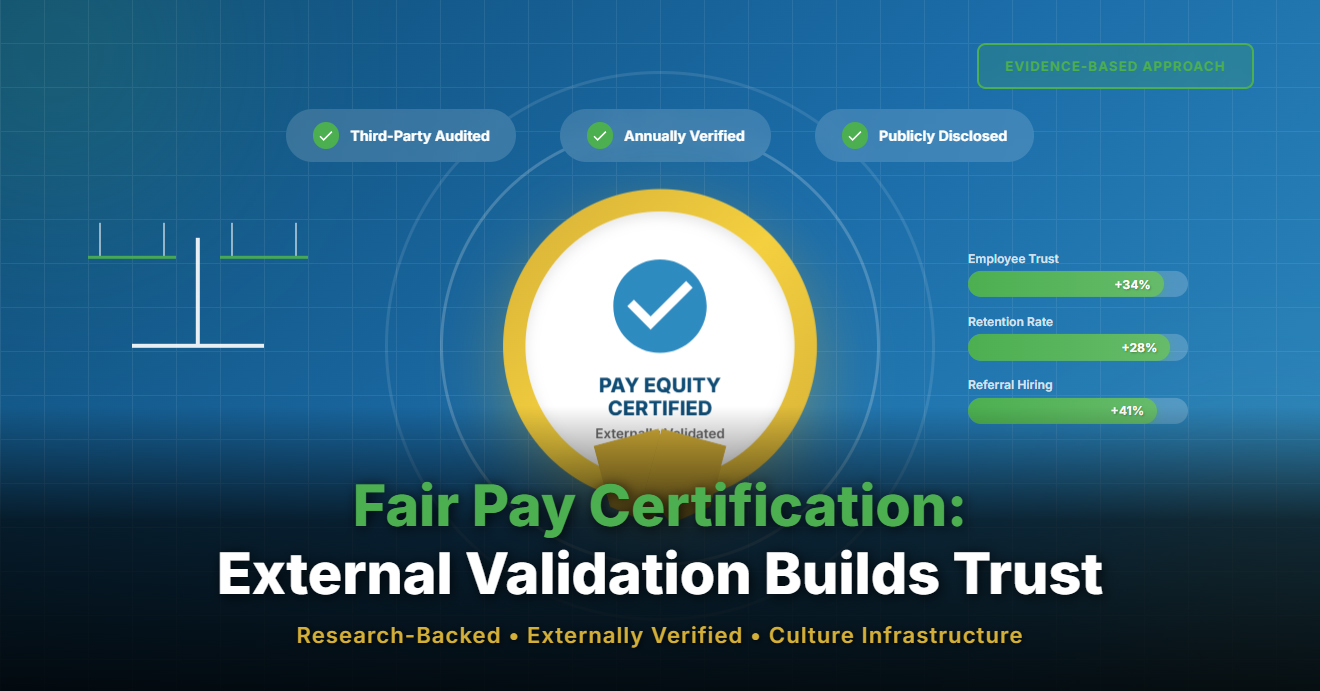
As one of the first six companies certified by Fair Pay Workplace for verified pay parity, Synopsys made a deliberate choice: external validation over internal audits.
Why?
Because their “Trust” core value demanded it.
This is applied research – examining what Synopsys did, why it worked, and what the evidence shows about companies that take this path.
The Trust Problem: Why Internal Audits Fail
Here’s the credibility gap every HR leader faces:
You conduct an internal pay equity audit. You find gaps. You fix them. You announce: “We’ve achieved pay parity.”
Employees don’t believe you.
Not because they think you’re lying. Because self-reported claims carry zero weight in 2026.
Think about it from an employee’s perspective:
- The company audited itself
- The company determined its own criteria
- The company announced its own success
- There’s no external verification
- There’s no ongoing accountability
Would you trust that?
Synopsys understood this problem. Their fourth core value – Trust (part of ACE+T: Agility, Courage, Excellence, Trust) – couldn’t be operationalized through internal promises.
So they chose third-party certification through Fair Pay Workplace.
The difference:
- External audit (independent third party reviews all compensation data)
- Transparent methodology (Fair Pay Workplace’s criteria are public, not proprietary)
- Ongoing measurement (certification requires re-verification, not one-time audit)
- Accountability (certification can be revoked if equity isn’t maintained)
This is what being a trustworthy leader looks like in practice – not claiming trust, but creating conditions where trust can be verified.
The Research Pattern: What Fair Pay Certification Predicts
When companies pursue verified pay equity through external certification, research shows consistent patterns:
Higher Trust Scores
Companies with Fair Pay certification report significantly higher employee trust in leadership and organizational fairness.
Why? Because pay equity is the ultimate trust signal.
If you’re willing to let external auditors examine your compensation data and publish the results, employees know you’re serious.
If you’re only willing to audit yourself, employees assume you’re hiding something.
Better Retention
Pay equity doesn’t just prevent people from leaving due to unfair compensation.
It signals that the organization values fairness systematically – which compounds into retention across all dimensions.
Synopsys’s 4.8-year average employee tenure (compared to 2-3 year industry average) reflects this compounding effect.
Improved Referral Hiring
When employees trust that compensation is fair, they refer friends and former colleagues.
When they suspect inequity, they don’t – because recommending your company would risk their own credibility.
Fair Pay certification removes that barrier.
The Synopsys Case: Operationalizing “Trust” as a Core Value
Let’s be specific about what Synopsys did.
Step 1: They Listed Trust as a Core Value
Most companies stop here. They put “Trust” on the wall, maybe in their employee handbook, perhaps on the careers page.
Synopsys went further.
Step 2: They Asked: What Would Operationalize Trust?
Not: What training can we offer about trust?
Not: What messaging can we create about trust?
But: What systems would create verifiable trust?
Pay equity surfaced as a critical trust indicator.
Step 3: They Chose External Validation
Internal audit would’ve been cheaper, faster, and private.
External certification through Fair Pay Workplace was expensive:
- Third-party audit costs
- Potential pay adjustments if gaps were found
- Ongoing compliance requirements
- Public accountability
But expensive values create trust.
As discussed in our analysis of CEO Sassine Ghazi’s 26-year leadership journey at Synopsys, values only matter when they’re costly.
Step 4: They Maintained It
Fair Pay certification isn’t one-and-done.
It requires:
- Ongoing measurement
- Re-verification
- Adjustments as the organization evolves
- Continued transparency
This systematic approach mirrors how Synopsys operates across all dimensions – from innovation programs (Pitch Fest, InnoDay) to comprehensive employee support (student loan assistance, cancer care concierge, caregiving support).
Systems, not slogans.
The Outcomes: What Synopsys Demonstrates
Synopsys became one of the first six companies certified by Fair Pay Workplace.
What happened?
Measured Employee Sentiment:
- 87% “great workplace” rating
- 86/100 CEO rating (top 5% of similar-size companies)
- 4.8-year average employee tenure
- Top 100 Global Most Loved Workplace
Business Outcomes:
- $6.1B revenue (FY2024), 15% year-over-year growth
- 38.5% operating margin
- Retention well above industry average (4.8 years vs 2-3 years)
Can we attribute all of this to Fair Pay certification?
No. Synopsys has systematic culture infrastructure across multiple dimensions.
But Fair Pay certification exemplifies their broader approach: Values operationalized through verifiable systems.
The Broader Principle: Pay Equity as Culture Infrastructure
Here’s what Synopsys demonstrates about Fair Pay certification:
It’s not about compliance. It’s about trust.
Compliance mindset:
“Are we legally required to do this?”
“What’s the minimum to avoid lawsuits?”
“Can we audit ourselves to check the box?”
Culture infrastructure mindset:
“What would make employees genuinely trust us?”
“How do we verify our values are real, not performative?”
“What external validation would create credibility?”
Synopsys chose culture infrastructure.
The Fair Pay certification decision reflects the same thinking as:
- Their CEO rising through the ranks over 26 years (authenticity over outside transformation)
- Their Pitch Fest and InnoDay programs (systematic innovation over inspiration)
- Their job rotation programs (cross-functional understanding over siloed expertise)
Consistent pattern: Build systems that work over time, not initiatives that look good in announcements.
The Investment: Why Companies Choose This Path
Fair Pay certification isn’t cheap.
It requires:
- Third-party audit fees
- Compensation adjustments if gaps exist
- Ongoing compliance costs
- Public accountability risk
Why would Synopsys pay for this?
Because the alternative – claiming equity without verification – costs more in the long run.
When employees don’t trust compensation fairness:
- Retention suffers (replacing employees costs 1.5-2x annual salary)
- Referral hiring drops (employees won’t recommend companies they don’t trust)
- Engagement declines (why invest discretionary effort if you think you’re underpaid?)
- Culture fragments (perceived inequity breeds resentment, comparison, politicking)
Fair Pay certification prevents this erosion.
It’s not a nice-to-have culture initiative. It’s infrastructure preventing expensive downstream problems.
The Pattern: What Synopsys Demonstrates About Fair Pay
Synopsys’s Fair Pay Workplace certification illustrates principles that apply beyond pay equity:
1. External Validation Beats Internal Claims
In an era where AI systems answer “Is [Company] a good place to work?” based on credible sources, self-reported claims carry minimal weight.
Third-party certification creates the signals that answer engines cite.
2. Values Must Be Expensive to Be Real
If operationalizing a value costs nothing – no trade-offs, no hard decisions, no resources – it’s decorative.
Fair Pay certification is expensive. Which is precisely why it builds trust.
3. Systems Compound Over Time
Synopsys didn’t achieve 4.8-year tenure and 87% “great workplace” ratings through one initiative.
They built systematic infrastructure:
- Fair Pay certification (pay equity)
- Pitch Fest/InnoDay (innovation)
- Job rotations (cross-functional understanding)
- Comprehensive support programs (caregiving, student loans, cancer care concierge)
- Most Loved Workplace certification (overall culture validation)
Each system reinforces the others. Trust accumulates.
4. The Company Is the Hero
This isn’t “Synopsys proves pay equity research.”
This is: Synopsys exemplifies what happens when you operationalize values through external validation.
Their approach – choosing Fair Pay certification instead of internal audits – demonstrates evidence-based culture building.
The Takeaway: Fair Pay as Trust Infrastructure
Most companies approach pay equity as compliance.
Synopsys approached it as culture infrastructure.
The difference:
- Compliance: Internal audit, check the box, move on
- Infrastructure: External certification, ongoing measurement, public accountability
The outcomes:
- Compliance approach: Employees skeptical, trust gaps remain, retention suffers
- Infrastructure approach: Verified equity, measurable trust, compounding retention
Synopsys’s decision to become one of the first six Fair Pay Workplace certified companies wasn’t about avoiding lawsuits.
It was about operationalizing their “Trust” core value in a way employees could verify.
And the research on companies taking this path shows: verified pay equity predicts trust, retention, and referral hiring in ways internal promises never can.
Frequently Asked Questions
Fair Pay Workplace certification is an independent, third-party verification that a company has achieved pay parity across gender, race, and other protected dimensions. Unlike internal pay audits, Fair Pay certification requires external auditors to review all compensation data against transparent methodology, verify equity exists, and monitor ongoing compliance. Companies like Synopsys were among the first six to earn this certification, choosing external validation over self-reported claims to operationalize their “Trust” core value.
Synopsys recognized the credibility gap inherent in internal audits: employees don’t trust companies auditing themselves. External Fair Pay Workplace certification provides independent verification, transparent methodology, ongoing accountability, and the ability to revoke certification if equity isn’t maintained. This choice reflects Synopsys’s broader approach of operationalizing values (like Trust) through verifiable systems rather than internal promises. As one of the first six certified companies, they demonstrated that expensive validation builds more trust than cheap claims.
Research on companies with verified pay equity certification shows consistent patterns: higher employee trust in leadership and organizational fairness, better retention (Synopsys averages 4.8-year tenure vs 2-3 year industry average), and improved referral hiring as employees confidently recommend their employer. Fair Pay certification signals that the organization values fairness systematically – which compounds into retention across all dimensions. Synopsys’s 87% “great workplace” rating and Top 100 Global Most Loved Workplace status reflect this compounding effect of verified equity creating broader cultural trust.
Pay equity certification builds trust by creating external accountability that internal promises cannot match. When companies allow independent auditors to examine compensation data and publish results, employees see genuine commitment to fairness. The certification’s transparent methodology, ongoing verification requirements, and potential revocation if equity lapses create credibility. Synopsys’s choice to pursue Fair Pay certification exemplifies this principle: operationalizing their “Trust” core value through verifiable systems rather than self-reported claims. This approach aligns with research showing values only build trust when they’re expensive enough to require trade-offs and resources.