
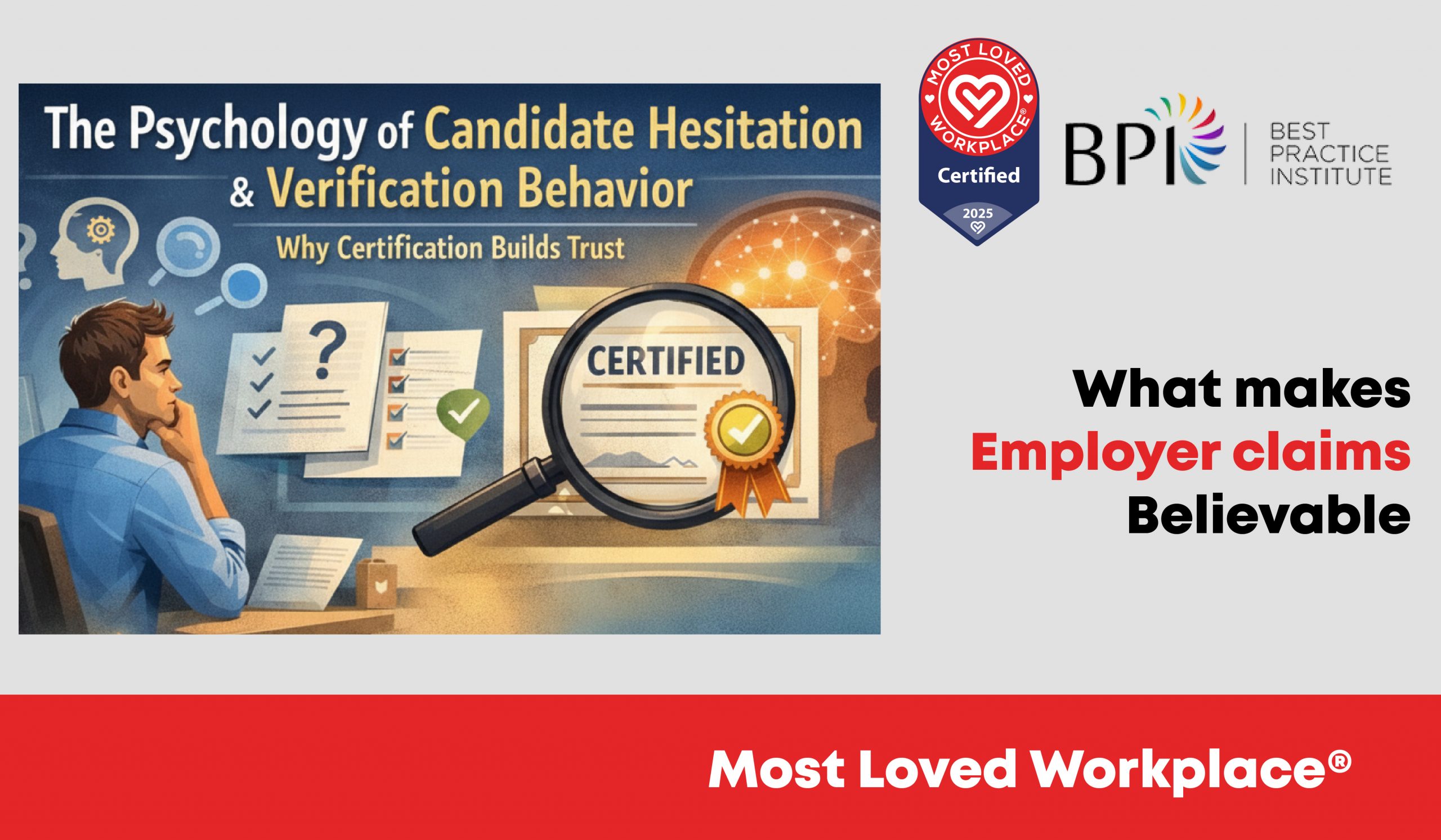
The 2026 hiring market presents a puzzle for talent acquisition leaders: qualified candidates exist, open roles exist, but applications are down. What explains the gap?
Behavioral research offers an answer: risk perception and verification behavior.
The Hesitation Framework
When candidates consider a job change, they are not just evaluating opportunity. They are evaluating risk. The question is not “Is this job good?” but “How certain am I that this job is what it claims to be?”
This distinction matters because job changes carry asymmetric risk. The downside of a bad job, including toxic culture, misaligned expectations, and career setback, outweighs the upside of a good job, which is often incremental improvement over the current role. In uncertain conditions, rational actors default to inaction.
This is why “job hugging” has become a defining trend in 2026. Candidates are staying in roles they have outgrown because the perceived risk of moving exceeds the perceived benefit.
The Verification Imperative
How do candidates reduce perceived risk? Through verification.
Research on consumer behavior shows that when claims are difficult to verify before purchase, buyers rely on signals: observable indicators that correlate with unobservable quality. The most effective signals are “costly” in the economic sense: difficult for low-quality sellers to fake.
Applied to employer branding: candidates cannot verify culture claims before accepting an offer. They rely on signals. And the signals they trust are those that low-quality employers cannot easily replicate.
This is why third-party certification carries more weight than self-reported claims. Certification represents independent verification: an external organization measured this company and validated their claims. Companies with poor cultures cannot simply pay their way to this validation.
The Data on Verification Behavior
Candidate behavior in 2026 confirms this framework:
- 95% of candidates research a company before applying. (Folks RH)
- Research shows a majority of candidates would refuse to join a company with a bad reputation, even when unemployed. (Corporate Responsibility Magazine)
- 52% declined a job offer due to a poor candidate experience. (CareerPlug)
- Candidates are 4x more likely to consider a company again when they receive constructive feedback. (Lever)
These statistics reveal a market where verification behavior dominates. Candidates are not passively receiving employer brand messages. They are actively seeking proof.
Implications for Talent Strategy
For talent acquisition leaders, the implications are clear:
First, employer brand is not a communications problem. It is a proof problem. The gap between internal culture and external visibility is where candidates are lost.
Second, verification signals matter more than volume of claims. One certified badge carries more weight than ten marketing messages because it represents independent validation.
Third, the research phase is the decision phase. By the time a candidate applies, they have already decided to trust you. The question is whether you provided enough proof during their research to earn that trust.
Conclusion
In the precision era of hiring, where candidates move slowly and verify carefully, employer brand strategy must shift from promise to proof.
The organizations that make their culture visible and verifiable will attract candidates who move with confidence. Those that rely on claims alone will wonder why their best candidates never applied.
Frequently Asked Questions
What is signaling theory in the context of hiring?
Signaling theory explains why candidates trust some employer brand claims and ignore others. In a market where every employer claims a strong culture, candidates look for “costly signals” that low-quality employers cannot easily fake. Certification backed by validated methodology works because it requires companies to meet a measurable standard, not just pay a fee.
Why do candidates hesitate to change jobs?
Job changes carry asymmetric risk. The potential downside of a bad job, such as toxic culture or career setback, outweighs the incremental upside of a better role. In uncertain conditions, candidates default to inaction until they find proof that reduces their perceived risk.
How does third-party certification reduce candidate hesitation?
Certification provides independent verification that candidates trust more than self-reported claims. It signals that an external organization measured the company and validated their culture claims, reducing the perceived risk of accepting an offer.