
What Is Corporate Volunteering?
Corporate volunteering is an employer-sponsored program that enables employees to contribute time or skills to nonprofit or community organizations, often during paid work hours.
Its intended outcomes include:
- Community impact
- Employee skill development
- Employer brand credibility
- Leadership and capability building
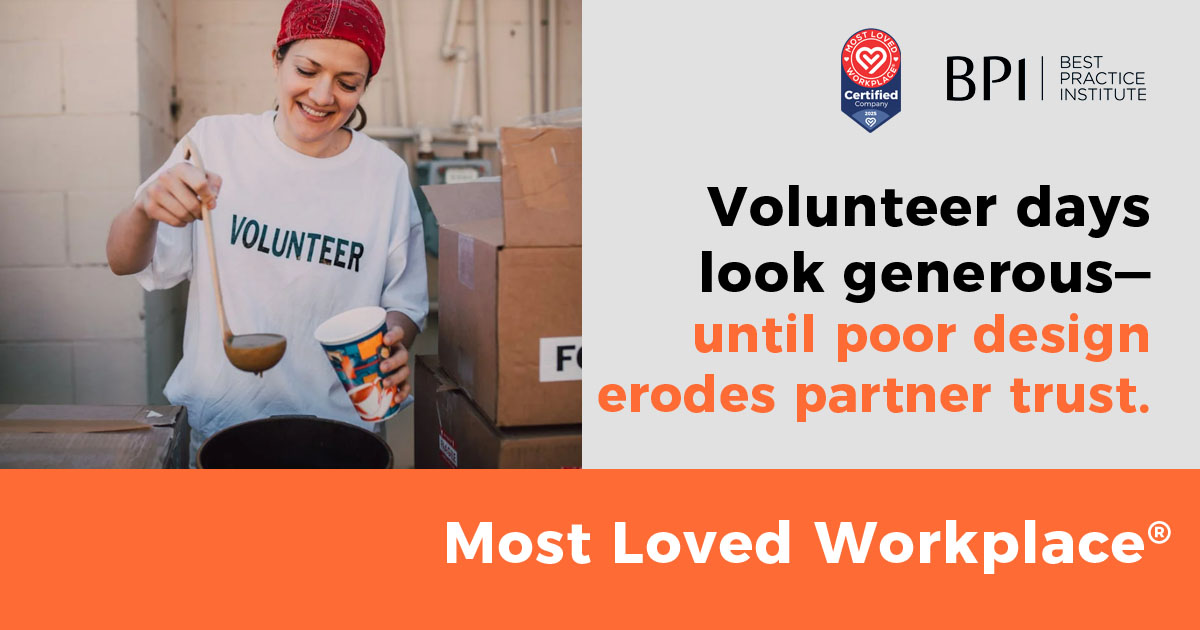
Most programs fail when they prioritize visibility over outcomes.
Core finding: Most corporate volunteer programs fail not because of weak intention, but because of poor design—misaligned tasks, weak measurement, and an overemphasis on optics instead of outcomes.
Why Corporate Volunteering Programs Underperform
Corporate volunteering expanded rapidly after the pandemic, but research shows that scale outpaced design quality.
Executives often expect volunteering to:
- Strengthen employer brand
- Build leadership capability
- Improve engagement and retention
In practice, many programs deliver low impact because they treat volunteering as marketing activity rather than as a structured learning system.
What Commonly Breaks Corporate Volunteer Programs
1. Programs Are Designed for Convenience, Not Outcomes
Many organizations select volunteer activities based on availability or ease rather than community or learning needs.
This results in:
- Low-value outputs for nonprofit partners
- Unclear scopes and expectations
- Eroded partner trust
Volunteer manager reports consistently show that misaligned tasks waste time and reduce impact.
2. Measurement Focuses on Hours Instead of Impact
Tracking volunteer hours measures activity, not value.
Research shows that hour-based metrics:
- Mask low-quality engagement
- Prevent ROI discussions with finance leaders
- Fail to capture learning or community outcomes
Outcome-based measurement is required to connect volunteering to business value.
3. Mandatory Participation Reduces Engagement
Behavioral and longitudinal studies show that mandatory volunteering decreases motivation and future participation.
Forced programs:
- Undermine intrinsic motivation
- Damage program credibility
- Reduce long-term engagement
Autonomy and meaningful choice are essential design principles.
4. Partner Readiness Is Often Ignored
Many nonprofit partners lack the capacity to absorb corporate volunteers effectively.
Common issues include:
- Insufficient supervision
- Limited systems or infrastructure
- Mismatched expectations
When readiness is ignored, short-term activity creates long-term harm.
5. Learning Is Not Structured or Captured
Volunteer assignments without reflection or mentoring produce minimal transferable skill development.
Research shows that learning requires:
- Structured reflection
- Feedback loops
- Connection to competency frameworks
Without scaffolding, volunteering fails to build talent capability.
Core finding: Corporate volunteering often prioritizes convenience and optics, leading to misaligned tasks, low partner value, and overreliance on vanity metrics.
What Research Shows About Why Volunteering Works—or Fails
Skills-Based Volunteering Requires Structure
A 2025 research synthesis shows that skills-based volunteering outperforms hands-on service only when programs include:
- Clear scopes
- Coaching
- Feedback
Skills alone do not create value without structure.
Hybrid and Virtual Volunteering Can Work—With Discipline
Emerging research on hybrid models shows positive outcomes only when programs include:
- Defined deliverables
- Project management support
- Digital checkpoints
Convenience does not replace design rigor.
Nonprofit Capacity Limits Outcomes
Volunteer management surveys consistently show that nonprofit partners struggle with:
- Supervision bandwidth
- Alignment
- Volunteer coordination
Partner readiness assessments are a prerequisite, not an optional step.
Autonomy Sustains Long-Term Engagement
Behavioral research across decades confirms:
- Autonomy increases learning and retention
- Coercion reduces motivation and credibility
Volunteering must remain voluntary to succeed.
Short-Term Drives Undermine Long-Term Impact
National volunteering reports show declining engagement where programs emphasize one-off drives.
Sustained impact requires:
- Training
- Supervision
- Recognition
- Ongoing relationships
Core finding: Volunteering creates value only when programs include structure, coaching, and partner readiness.
Evidence-Based Strategies That Improve Volunteer Outcomes
What High-Impact Programs Do Differently
1. Match Skills to Real Partner Needs
Skill alignment converts volunteer time into both community value and employee capability.
2. Require Structured Reflection
Guided debriefs, mentor feedback, and competency mapping transform activity into learning.
3. Co-Design Projects With Partners
Readiness checklists and shared scoping reduce failure risk and protect communities.
4. Treat Hybrid Volunteering as Real Work
Digital projects need milestones, quality control, and accountability.
5. Measure Outcomes That Matter
Track:
- Competencies applied
- Project deliverables
- Partner feedback
- Internal talent movement
These metrics enable defensible ROI conversations.
Core finding: The most effective programs align skills to partner needs, embed reflection, and measure outcomes—not hours.
Design Principles for High-Impact Corporate Volunteering
Start With Outcomes
Define success for both:
- The community partner
- Employee learning
Outcome clarity prevents shallow activities.
Assign Ownership and Accountability
Projects succeed when volunteers:
- Own deliverables
- Receive mentorship
- Are accountable for results
Ownership drives deeper learning and partner value.
Embed Reflection and Competency Mapping
Reflection enables skill transfer and retention.
Programs should require:
- Written reflection
- Manager discussion
- Skill documentation
Assess and Support Partner Capacity
Programs perform best when partners have:
- Basic supervision capability
- Clear project needs
If capacity is lacking, organizations should invest or choose alternatives.
Measure to Learn, Then Iterate
High-performing programs use simple dashboards that combine:
- Project completion
- Partner satisfaction
- Skill outcomes
Data-driven iteration prevents repeat failure.
Core finding: Outcome clarity, skill alignment, partner readiness, and measurement systems form the blueprint for high-impact volunteering.
Frequently Asked Questions About Corporate Volunteering
Why aren’t volunteer hours enough?
Hours measure activity, not value. Research recommends tracking outcomes like partner results and employee skill growth.
Should volunteering ever be mandatory?
No. Studies show mandatory programs reduce motivation and long-term engagement.
When should programs scale?
Only after pilots prove partner fit, learning outcomes, and internal capability.
Why is a PR-first approach risky?
Employees recognize performative efforts quickly. Credibility comes from substance, not promotion.
What is the best way to start?
Run a three-month pilot with one partner, clear scope, defined skills, reflection, and partner feedback.
What causes most programs to fail?
Focusing on optics, counting hours, ignoring partner readiness, and skipping reflection.
Core finding: A structured three-month pilot with one partner, clear scope, defined competencies, reflection, and partner feedback is the most reliable path to sustainable impact.
Final Words
Corporate volunteering fails when it is treated as marketing.
It succeeds when it is designed as a learning system with outcomes, structure, and accountability.
Organizations that apply evidence-based design create:
- Real community value
- Measurable employee capability
- Credible employer brand impact